Why Balance Training Is the Missing Link in Your Fitness Routine
You hit the gym regularly, crush cardio, and strength train like a pro—yet something feels off. That *something* might be balance. Often overlooked, balance training is not just for athletes or older adults. It’s a core element of functional fitness that enhances coordination, prevents injury, and improves daily movement. Backed by science and used by professionals, integrating balance work can transform how your body performs—both in and out of the gym. Let’s break down why it matters and how to do it right.
The Hidden Problem: Why Modern Fitness Lacks Balance
In today’s fitness culture, results are often measured by visible markers: muscle tone, endurance milestones, or the number on the scale. Workouts are designed to push limits—longer runs, heavier lifts, faster intervals. Yet, one critical component consistently falls through the cracks: balance. Despite its foundational role in movement, balance training is rarely included in mainstream fitness routines. This oversight creates a gap between strength and stability, leaving even the most dedicated exercisers vulnerable to inefficiency and injury.
The modern lifestyle amplifies this imbalance. Hours spent sitting—whether at a desk, in a car, or on the couch—lead to weakened core muscles, tight hips, and diminished proprioception, the body’s ability to sense its position in space. These physical changes subtly degrade posture and coordination. Over time, this manifests in small but telling ways: stumbling on uneven sidewalks, wobbling during yoga poses, or needing to steady oneself when standing up too quickly. These are not just minor inconveniences; they are early warning signs of compromised stability.
Muscle imbalances are another consequence of unbalanced training. Many fitness programs emphasize large muscle groups like the quads, chest, and back, while underutilizing stabilizing muscles such as the gluteus medius, deep core fibers, and intrinsic foot muscles. When prime movers overpower their supporting counterparts, movement patterns become inefficient. This can lead to overuse injuries, particularly in the knees, hips, and lower back. For example, a runner with weak hip stabilizers may develop iliotibial (IT) band syndrome, not due to lack of conditioning, but due to poor neuromuscular control.
Moreover, the absence of balance work limits functional fitness—the ability to perform everyday tasks safely and efficiently. Carrying groceries, climbing stairs, or lifting a child require more than raw strength; they demand coordination, control, and body awareness. Without balance training, these activities become more taxing and more prone to mishaps. The truth is, no amount of bicep curls or treadmill miles can fully prepare the body for real-world movement if stability is neglected.
What Exactly Is Balance Training? (And Why It’s Not Just Standing on One Foot)
Beyond the common image of standing on one leg, balance training is a sophisticated system of neuromuscular coordination that integrates multiple sensory inputs to maintain control over the body’s position. It’s not merely a physical skill but a dynamic process involving the brain, nervous system, and musculoskeletal structure working in harmony. At its core, balance training enhances the body’s ability to respond to internal and external forces—whether shifting weight, navigating a crowded sidewalk, or recovering from a misstep.
Three primary systems contribute to balance: the visual, vestibular, and proprioceptive systems. The visual system provides information about the environment, helping the brain understand spatial orientation. The vestibular system, located in the inner ear, detects head motion and spatial orientation, playing a crucial role in equilibrium. The proprioceptive system, often referred to as the body’s “sixth sense,” relies on sensory receptors in muscles, tendons, and joints to relay information about limb position and movement. When these systems work together seamlessly, balance is maintained with minimal conscious effort.
Balance training challenges and refines this integration. Simple exercises like standing on one leg with eyes closed, for example, reduce reliance on vision and force the body to depend more on vestibular and proprioceptive feedback. This strengthens neural pathways and improves reaction time. More advanced drills, such as performing a lunge on an unstable surface, require continuous micro-adjustments, engaging deep stabilizing muscles that are often dormant during traditional strength training.
Contrary to popular belief, balance training is not limited to rehabilitation or fall prevention for older adults. It is a performance-enhancing tool used by elite athletes across disciplines. Gymnasts rely on exceptional balance for precise landings; tennis players use it to change direction rapidly; and weightlifters depend on it to maintain proper form under heavy loads. For the general population, incorporating balance work improves movement quality, reduces energy waste, and increases confidence in physical tasks. It transforms fitness from isolated muscle development into integrated, functional capability.
Science-Backed Benefits: What Research Says About Stability Work
Scientific research consistently supports the inclusion of balance training in comprehensive fitness programs. Studies in sports medicine and rehabilitation have demonstrated that stability exercises lead to measurable improvements in joint integrity, neuromuscular control, and injury prevention. One key finding is that balance training activates stabilizing muscles—such as the transverse abdominis, multifidus, and gluteus medius—before the larger prime movers engage. This anticipatory muscle activation, known as feedforward control, is essential for protecting joints during dynamic movements.
A review published in the Journal of Strength and Conditioning Research found that individuals who incorporated balance exercises into their routines experienced a significant reduction in ankle sprains, particularly among athletes with a history of instability. This is attributed to improved proprioception and enhanced muscle responsiveness around the joint. Similarly, research in the British Journal of Sports Medicine showed that balance training reduced the risk of anterior cruciate ligament (ACL) injuries in female athletes by up to 50% when combined with plyometric and strength drills. The mechanism lies in better landing mechanics and increased control during sudden directional changes.
Balance training also plays a vital role in post-injury recovery. For individuals recovering from concussions, controlled balance exercises are a cornerstone of vestibular rehabilitation. These activities help retrain the brain to process spatial information accurately, reducing dizziness and improving coordination. Physical therapists often use progressively challenging balance tasks—such as tandem stance on foam or gaze stabilization exercises—to support neurological recovery without overexertion.
Additionally, balance work has been shown to improve motor control in everyday populations. A study involving middle-aged adults found that just six weeks of regular balance training led to measurable gains in gait stability, reaction time, and postural control. These improvements translated into greater confidence during daily activities and a reduced fear of falling—a critical factor in maintaining independence and quality of life. The science is clear: stability training is not a niche add-on but a fundamental component of long-term physical resilience.
Who Really Needs It? (Spoiler: It’s Everyone)
Despite common misconceptions, balance training is not reserved for the elderly or those recovering from injury. Its benefits are universal, spanning all ages, fitness levels, and lifestyles. Whether you’re a weekend hiker, a busy parent, or a seasoned gym-goer, your body relies on balance for safe and efficient movement. The reality is that every person, regardless of age or activity level, experiences moments that demand stability—stepping off a curb, reaching for a high shelf, or catching yourself when you trip. Being prepared for these moments begins with consistent balance practice.
Runners, for instance, can greatly benefit from balance work. The repetitive motion of running places significant stress on joints, particularly the knees and ankles. Weak stabilizing muscles increase the risk of common overuse injuries like shin splints, plantar fasciitis, and patellofemoral pain syndrome. By incorporating single-leg balance drills and dynamic stability exercises, runners improve foot and hip control, leading to smoother stride mechanics and reduced injury risk. Even a few minutes of balance training after a run can enhance neuromuscular coordination and promote recovery.
Lifters, too, stand to gain. Proper form during squats, deadlifts, and overhead presses depends on core stability and joint control. Without adequate balance, even strong individuals may compensate with poor posture, increasing strain on the spine and connective tissues. Adding balance challenges—such as performing a squat on a foam pad or holding a single-leg deadlift—forces the body to engage stabilizing muscles that support safe lifting mechanics. This not only reduces injury risk but also improves lifting efficiency and power output.
For office workers and others with sedentary routines, balance training counteracts the physical decline associated with prolonged sitting. Poor posture, weakened glutes, and tight hip flexors contribute to instability and discomfort. Simple balance exercises, like standing on one leg while brushing teeth or performing heel-to-toe walks during a break, can reawaken dormant muscles and improve body awareness. Over time, these small efforts lead to better posture, reduced back pain, and increased energy. The message is clear: balance training is not a specialty—it’s a necessity for anyone who moves.
Simple Ways to Integrate Balance Into Any Routine
The beauty of balance training lies in its accessibility. Unlike specialized equipment or complex techniques, many effective balance exercises require no gear and can be done in minimal time. The key is consistency and intentionality. Even two to five minutes a day can yield noticeable improvements in stability and coordination. The goal is not perfection but progression—starting with basic movements and gradually increasing difficulty as control improves.
One of the simplest exercises is the single-leg stand. Stand on one foot, keeping the knee slightly bent and the core engaged. Hold for 30 seconds, then switch sides. To increase the challenge, try closing your eyes or standing on a soft surface like a folded towel. This reduces visual and tactile feedback, forcing the body to rely more on proprioception. Another effective drill is the heel-to-toe walk, where you walk in a straight line placing the heel of one foot directly in front of the toes of the other. This mimics the narrow base of support used in daily navigation and enhances dynamic balance.
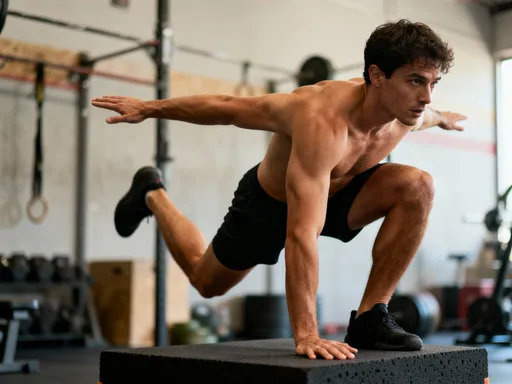
For those already engaged in strength or cardio workouts, balance can be seamlessly integrated. After completing a set of lunges, for example, hold the front position and lift the back knee for an extra five seconds to challenge stability. During a plank, lift one leg slightly off the ground to engage deeper core muscles. These micro-adjustments turn familiar exercises into balance-enhancing drills without extending workout time.
Using household items can also add variety. A pillow or foam pad placed on the floor creates an unstable surface for squats or push-ups, activating stabilizing muscles more intensely. A countertop or chair can serve as a light support for beginners learning to balance on one leg. The emphasis should always be on control and alignment, not speed or repetition. Over time, these small integrations build a foundation of stability that supports all physical activity.
Advanced Techniques for Performance and Precision
Once foundational balance skills are established, individuals can progress to more advanced techniques that further enhance neuromuscular control and body awareness. These exercises are particularly beneficial for those seeking to improve athletic performance, refine movement precision, or prepare for physically demanding activities. The key to progression is mastering form before increasing difficulty—rushing into advanced drills without proper control can increase injury risk.
Single-leg deadlifts are a powerful progression that combines strength, balance, and coordination. Standing on one leg, hinge at the hips while extending the other leg behind you, lowering the torso until it is nearly parallel to the floor. This movement challenges the hamstrings, glutes, and lower back while demanding core stability to prevent rotation. Using light dumbbells increases the load but should only be attempted once balance is solid. This exercise not only strengthens key posterior chain muscles but also improves dynamic stability during walking and running.
Bosu ball training offers another level of challenge. The Bosu, with its flat side down and dome side up, creates an unstable surface ideal for balance drills. Squats performed on the dome require constant micro-adjustments, engaging the feet, ankles, and deep core muscles more than floor-based squats. Similarly, standing on the Bosu while performing shoulder presses or bicep curls forces the body to stabilize against unpredictable movement, enhancing functional strength.
Plyometric exercises with a balance focus—such as jump squats with a controlled landing—train the body to absorb force efficiently. The emphasis is not on height or speed but on landing softly with knees aligned over toes and minimal wobble. This develops joint resilience and teaches proper mechanics for high-impact activities. Eyes-closed balance drills, such as standing on one leg with eyes shut, further challenge the vestibular and proprioceptive systems, promoting greater neural adaptability. These advanced techniques, when performed safely and progressively, elevate physical performance and reduce the likelihood of injury in dynamic environments.
Making It Stick: Building a Sustainable Habit
Like any fitness habit, the long-term success of balance training depends on consistency, not intensity. Many people start with enthusiasm but struggle to maintain practice because they expect immediate results or view balance work as separate from their main routine. The most effective approach is to treat balance as a daily skill, like brushing your teeth or stretching, rather than a workout add-on. Small, repeated efforts compound over time, leading to meaningful improvements in stability and confidence.
Behavioral strategies can support adherence. One effective method is habit stacking—linking balance practice to an existing daily routine. For example, stand on one leg while brushing your teeth, or perform heel-to-toe walks while waiting for the coffee to brew. These micro-sessions require no extra time and reinforce the behavior through repetition. Another strategy is using visual feedback, such as practicing in front of a mirror to monitor posture and alignment. Some individuals find tracking helpful, marking a calendar each day they complete a balance drill to build a sense of accomplishment.
Technology can also play a supportive role. While no specialized apps are required, simple timer apps can help structure practice—setting a 60-second interval for each balance exercise. Video demonstrations from reputable fitness or physical therapy sources can guide proper form and introduce new variations. However, the focus should remain on mindful movement rather than digital engagement. The goal is not to achieve a high score or complete a challenge but to cultivate body awareness and control.
It’s also important to shift the mindset from performance to presence. Balance training is not about how long you can stand on one leg but how well you can focus on your body’s signals. Some days will feel easier than others, and that’s normal. Fatigue, stress, or minor illness can affect stability—these fluctuations are not failures but feedback. By approaching balance with patience and curiosity, individuals develop a deeper connection to their bodies, which enhances not only physical performance but overall well-being.
Beyond the physical benefits, consistent balance practice fosters a sense of empowerment. As stability improves, so does confidence in movement. Simple tasks become easier, falls become less likely, and physical independence is preserved. For women in their 30s to 50s—often balancing careers, family, and personal health—this sense of control is invaluable. Balance training becomes more than exercise; it becomes a form of self-care, a daily commitment to moving safely and with purpose through life.